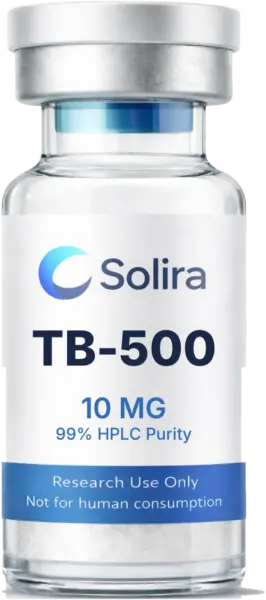
TB-500
Synthetic Thymosin Beta-4 Fragment
You save $30.80 Stock the Shelf applied automatically at checkout — no code needed
Direct-source pricing: Solira works through manufacturing partnerships to reduce reseller markup while maintaining independent third-party testing and lot-specific COA verification.
Estimated delivery Wed, Oct 14 – Tue, Oct 20
Availability: In stock
Quick facts
- Type
- Synthetic peptide fragment of Thymosin Beta-4
- Purity
- HPLC-verified (see COA)
- Testing
- Third-party HPLC + mass spectrometry
- Form
- Lyophilized powder
- Shipping
- Same-day (orders before 3 PM ET)
- Use
- In-vitro laboratory research only
The Solira Take
TB-500 is a synthetic fragment representing the active region of thymosin beta-4 (residues 17-23 of the full protein). Characterized in preclinical research on actin-binding and tissue-modulation pathways.
Research reference
COA / Testing
Every batch of product sold by Solira undergoes independent third-party analytical testing to verify identity and purity, performed by Chromate.
- HPLC purity analysis — confirms compound purity
- Mass spectrometry — identity confirmation via molecular weight verification
- Lot-specific documentation — each COA corresponds to the specific manufacturing lot
COA available upon request. Contact us for lot-specific documentation.
Description
What is TB-500?
TB-500 is a synthetic peptide fragment derived from Thymosin Beta-4 (gene symbol TMSB4X), a 43-amino-acid protein found endogenously in nearly all human and mammalian cells. The TB-500 fragment corresponds to the active region of Thymosin Beta-4 that mediates its primary biochemical function: binding to monomeric G-actin. Molecular formula C212H350N56O78S, molecular weight approximately 4,963 g/mol. Solira supplies TB-500 as a lyophilized white powder in sealed vials for laboratory research only.
Research Context
TB-500 is studied across the preclinical literature in cytoskeletal research, with particular focus on actin-binding kinetics and cellular migration assays. Standard research models include cultured endothelial cells, fibroblast cell lines, and in-vitro wound-closure assay systems. The compound's high water solubility makes it well-suited to standard aqueous buffer systems used in cell-culture protocols, and its larger molecular size relative to BPC-157 places it in a different physicochemical category for purification and storage methodology.
Mechanism of Action (Research Framing)
The published primary mechanism of TB-500 centers on its high-affinity binding to monomeric G-actin via a specific actin-binding motif preserved within the fragment sequence. By sequestering G-actin from the cellular monomer pool, the peptide modulates the dynamic equilibrium between G-actin (monomer) and F-actin (polymer) — the central machinery of cell motility, cytoskeletal remodeling, and intracellular cargo transport.
Specific molecular interactions documented in the published literature include:
- Actin sequestration — the canonical primary mechanism; the fragment binds one G-actin monomer per peptide molecule with submicromolar affinity in published binding studies
- Integrin signaling — secondary literature investigates TB-500's modulation of cell-surface integrin engagement and downstream focal adhesion kinase pathway research
- VEGF expression — published work in cultured endothelial models examines TB-500 effects on vascular endothelial growth factor transcription
- MAPK cascade activation — downstream signaling research in cultured cell preparations
The peptide is also used as a research probe for actin-dependent cellular processes in mechanistic studies where actin dynamics are the experimental endpoint.
Standard Research Assays
Published TB-500 research commonly employs the following methodologies:
- F-actin polymerization assays measuring fluorescence kinetics of labeled actin
- Scratch-wound migration assays in cultured endothelial or fibroblast monolayers
- Transwell migration and invasion assays
- Immunofluorescence staining for actin cytoskeleton organization (phalloidin labeling)
- Live-cell imaging of migration kinetics in time-lapse microscopy
- qPCR and Western blot analysis of integrin and VEGF expression in treated cultures
- Capillary tube formation assays in Matrigel for angiogenesis research
- Co-immunoprecipitation studies of actin-binding partner proteins
- Surface plasmon resonance for direct measurement of G-actin binding kinetics
- Confocal microscopy of cytoskeletal reorganization in live cells
- Atomic force microscopy of cytoskeletal mechanical properties
- Mass spectrometry-based proteomics for actin-interactome characterization following exposure
- High-content imaging screens with automated quantification of cellular migration phenotype across multi-well plate formats
The compound's actin-binding affinity is well-characterized; researchers replicating published binding kinetics should verify their stock solution concentration via absorbance at 215 nm or quantitative HPLC before assay setup.
Why Purity Matters for Research Validity
For a 43-residue-class peptide fragment like TB-500, common synthesis byproducts include truncated sequences (chains missing one or more amino acids at the N- or C-terminus), deletion mutants, and oxidation variants — particularly at methionine residues. A 95% pure TB-500 sample may contain enough truncated fragment to skew actin-binding kinetics measurements by 10–15%, which is precisely the effect size most published binding assays are designed to detect. The difference between research-grade and laboratory-grade purity is therefore not academic; it determines whether your data is signal or artifact.
Solira's independent HPLC verification preserves the signal-to-noise ratio that reproducible research demands, with each lot's measured purity documented on its COA.
Solira's Quality Verification
Every lot of TB-500 from Solira is independently HPLC-tested and mass spectrometry-confirmed by third-party laboratories. The lot-specific Certificate of Analysis documents the lot number, methodology, equipment specifications, and the exact purity figure for the lot in your vial. Match the lot on the COA to the lot stamped on your vial — they will be identical. See Solira's full verification process →
Storage & Handling
Lyophilized TB-500 is stable for 24 months or longer when stored at −20°C in its sealed vial. Protect from moisture and light; brief room-temperature shipping exposure does not compromise integrity. Once reconstituted in bacteriostatic water or sterile saline, store the resulting solution refrigerated and use within the validated stability window for your specific assay system. Larger peptides like TB-500 are particularly sensitive to freeze-thaw cycles in solution — aliquot before freezing. View Solira's compound reference database →
Product Specs
Research Applications
- Investigated in preclinical models for G-actin sequestration and cytoskeletal remodeling pathways.
- Studied in in vitro systems for endothelial cell migration and angiogenic signaling.
- Used in laboratory research examining stem/progenitor cell recruitment in repair models.
- Evaluated in controlled preclinical studies for extracellular matrix remodeling dynamics.
Storage & Handling
Store sealed, dry, and protected from light.
Long-term storage: -20°C recommended.
Short-term storage: 2-8°C acceptable.
Reconstitution: Use sterile technique with bacteriostatic water.
Post-reconstitution: Stable up to 30 days at 2-8°C.
All handling instructions are intended for laboratory use only.
Sold to qualified researchers for laboratory use only. These products have not been evaluated by the FDA, are not intended to diagnose, treat, cure or prevent any disease, and are not for human, veterinary, or food use in any form. The purchaser is responsible for the lawful and proper use of any compound purchased.