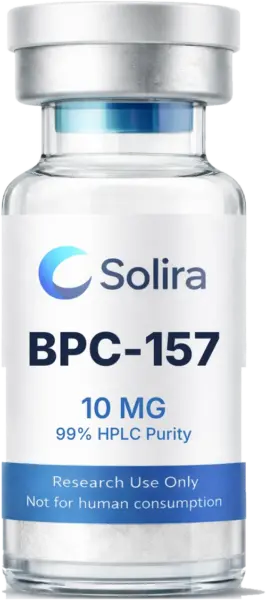
BPC-157
Synthetic Pentadecapeptide
You save $19.60 Stock the Shelf applied automatically at checkout — no code needed
Direct-source pricing: Solira works through manufacturing partnerships to reduce reseller markup while maintaining independent third-party testing and lot-specific COA verification.
Estimated delivery Wed, Oct 14 – Tue, Oct 20
Availability: In stock
Quick facts
- Type
- Synthetic pentadecapeptide (15 amino acids)
- Purity
- HPLC-verified (see COA)
- Testing
- Third-party HPLC + mass spectrometry
- Form
- Lyophilized powder
- Shipping
- Same-day (orders before 3 PM ET)
- Use
- In-vitro laboratory research only
The Solira Take
BPC-157 is a synthetic pentadecapeptide derived from gastric protective protein BPC. Among the most-cited compounds in preclinical tissue-modulation literature, with extensive in-vitro and animal-model characterization.
Research reference
COA / Testing
Every batch of product sold by Solira undergoes independent third-party analytical testing to verify identity and purity, performed by Chromate.
- HPLC purity analysis — confirms compound purity
- Mass spectrometry — identity confirmation via molecular weight verification
- Lot-specific documentation — each COA corresponds to the specific manufacturing lot
Tested lot BP6-451
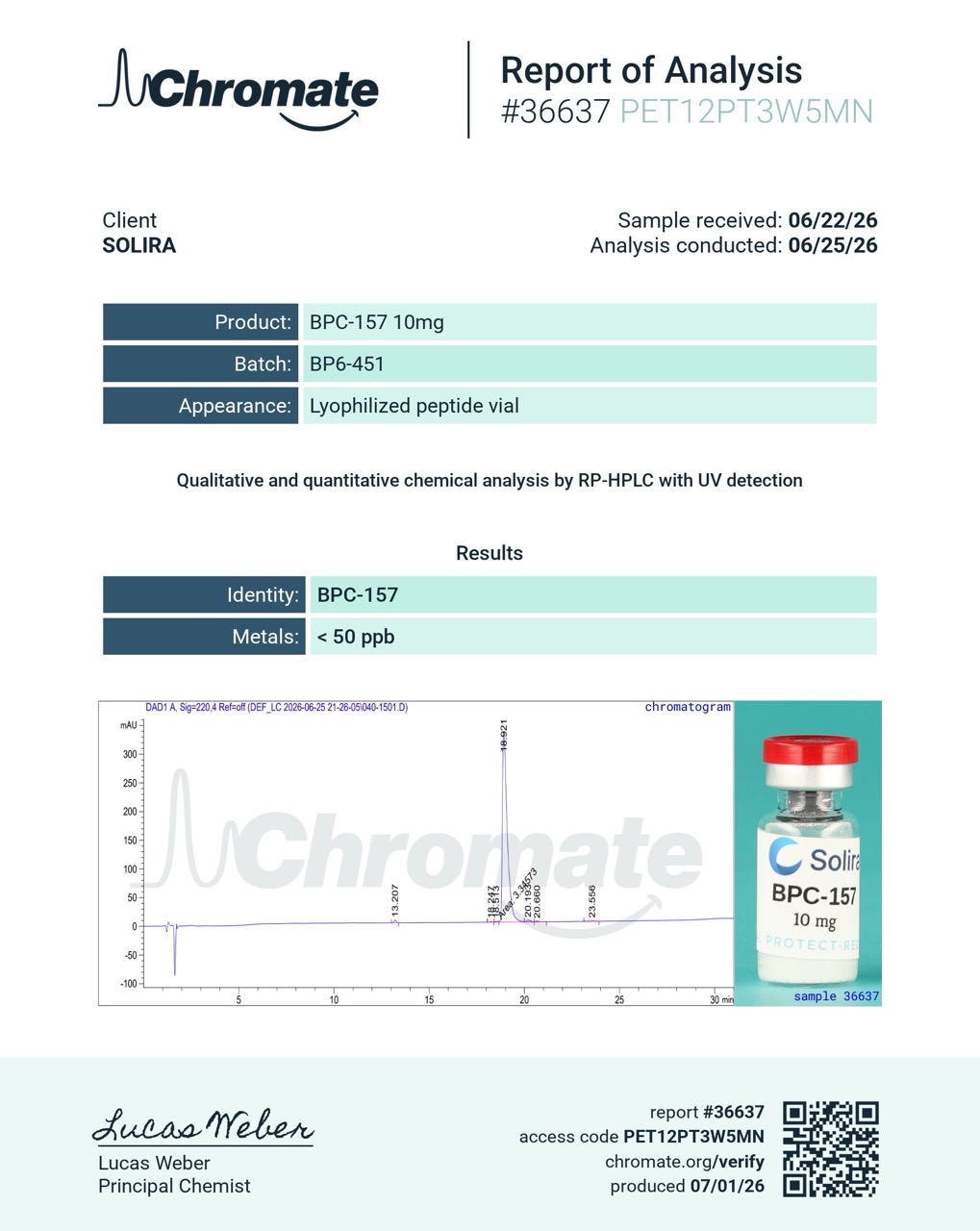
The full lab results for this lot are published in text on its Certificate of Analysis page. Each figure is also independently verifiable at Chromate, the testing laboratory.
Description
What is BPC-157?
BPC-157 — also written as BPC 157 or Body Protection Compound-157 — is a synthetic pentadecapeptide, a chain of 15 amino acids with sequence Gly-Glu-Pro-Pro-Pro-Gly-Lys-Pro-Ala-Asp-Asp-Ala-Gly-Leu-Val. The peptide corresponds to a partial sequence derived from a larger protein originally characterized in mammalian gastric juice. Its molecular formula is C62H98N16O22 with a molecular weight of 1,419.53 g/mol. CAS number 137525-51-0. Solira supplies BPC-157 as a lyophilized white powder in sealed vials for in-vitro laboratory research only.
Research Context
BPC-157 is studied across the preclinical research literature in models of connective tissue science, including tendon, ligament, and gastrointestinal mucosa investigations. Standard research models include rodent in-vivo preparations and a range of cultured cell lines used for migration, adhesion, and wound-closure assays. The compound's published profile of stability in acidic environments — it survives gastric juice intact, a property that destroys most peptide structures — has also made it a reference compound in peptide stability research.
Mechanism of Action (Research Framing)
Published preclinical literature investigates BPC-157's interactions with several signaling pathways relevant to tissue research. Among the most-studied:
- Vascular growth factor signaling — modulation of VEGF and FGF expression in cultured endothelial and fibroblast preparations
- Nitric oxide pathway — interaction with the NO/eNOS system, studied in vascular research models
- Neurotransmitter system research — published work on dopaminergic and serotonergic pathways in rodent in-vivo preparations, generally as exploratory mechanistic studies
- Gut-brain axis research — preliminary literature on enteric nervous system interactions, characterized as exploratory and not established
The compound's signature property in the literature — its remarkable stability in gastric juice — has driven its adoption as a benchmark peptide in studies of peptide chemistry and oral bioavailability research. Researchers selecting BPC-157 for in-vitro work should consult the published methodology in their target literature directly.
Standard Research Assays
Published research using BPC-157 commonly employs the following in-vitro and ex-vivo methodologies:
- Scratch-wound migration assays in cultured fibroblast or endothelial monolayers
- ELISA panels measuring VEGF, FGF, and related growth factor expression in culture supernatants
- Western blot analysis of downstream signaling cascade activation (MAPK, PI3K/Akt)
- Histological evaluation of tendon and ligament tissue from rodent in-vivo preparations
- qPCR analysis of growth factor and extracellular matrix gene expression
- Hydroxyproline content quantification in collagen-research preparations
- Transmission electron microscopy of treated tissue ultrastructure
- Flow cytometry analysis of cell viability and proliferation markers
- Immunohistochemistry for tissue-resident cell-type identification post-experiment
- Tensile-strength biomechanical testing in ex-vivo tendon and ligament research preparations
Researchers integrating BPC-157 into novel assay systems should validate purity and concentration in their own buffer system before drawing conclusions.
Why Purity Matters for Research Validity
Research-grade BPC-157 must be high-purity to produce reproducible experimental data. Sub-threshold purity introduces synthesis-byproduct peptides (truncated chains, deletion sequences) and free amino acids that compete in binding assays, distort concentration-response measurements, and contaminate downstream proteomics analysis. A 95% pure sample is not 4% "almost as good" as 99% pure — the 5% impurity actively changes the chemistry of every assay well, every cell culture, and every measurement it touches.
Solira independently HPLC-verifies every lot, and the measured purity is documented on its COA — no relabeling, no blending to mask a weak lot, no "rounding up." Research integrity requires that the label match the lot, and the lot match the data.
Solira's Quality Verification
Every lot of BPC-157 from Solira undergoes independent third-party HPLC analysis plus mass spectrometry confirmation before release. Each vial ships with a lot-specific Certificate of Analysis documenting the exact lot number, manufacturing date, test date, testing laboratory, methodology, and resulting purity percentage. Researchers can match the lot stamped on the vial to the lot on the COA — eliminating the chain-of-evidence gap that arises when a supplier re-uses a single batch COA across multiple downstream manufacturing runs. See our full verification process →
Storage & Handling
Lyophilized BPC-157 is stable for 24 months or longer when stored at −20°C in its sealed vial, protected from light and moisture. Brief room-temperature exposure during shipping does not compromise integrity. Once reconstituted in bacteriostatic water or sterile saline, the resulting solution must be kept refrigerated and used within the stability window appropriate to the specific research assay; this varies by buffer system and storage temperature. Aliquot reconstituted material before freezing to avoid repeated freeze-thaw cycles. View Solira's full compound reference database →
Product Specs
Research Applications
- Investigated in preclinical models for angiogenic signaling pathways and VEGF expression in controlled in vitro systems.
- Studied in laboratory research examining extracellular matrix dynamics and fibroblast migration.
- Used in preclinical tissue-repair research on cytoprotective pathways and nitric oxide system modulation.
- Evaluated in in vitro systems for gastrointestinal epithelial cell behavior and barrier function studies.
Storage & Handling
Store sealed, dry, and protected from light.
Long-term storage: -20°C recommended.
Short-term storage: 2-8°C acceptable.
Reconstitution: Use sterile technique with bacteriostatic water.
Post-reconstitution: Stable up to 30 days at 2-8°C.
All handling instructions are intended for laboratory use only.
Sold to qualified researchers for laboratory use only. These products have not been evaluated by the FDA, are not intended to diagnose, treat, cure or prevent any disease, and are not for human, veterinary, or food use in any form. The purchaser is responsible for the lawful and proper use of any compound purchased.