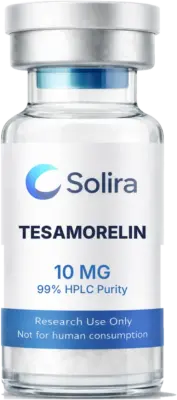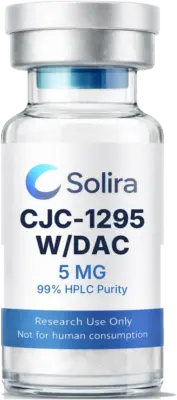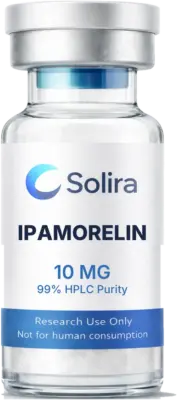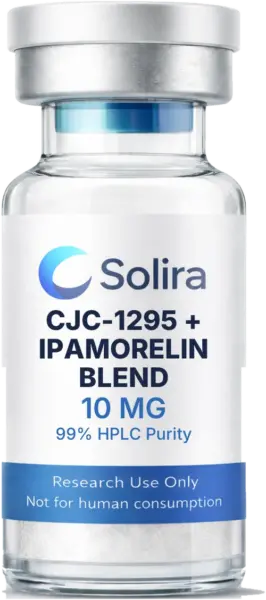
CJC-1295 + Ipamorelin Blend
Synthetic GHRH/GHSR Agonist Blend
You save $29.60 Stock the Shelf applied automatically at checkout — no code needed
Direct-source pricing: Solira works through manufacturing partnerships to reduce reseller markup while maintaining independent third-party testing and lot-specific COA verification.
Estimated delivery Wed, Oct 14 – Tue, Oct 20
Availability: In stock
Quick facts
- Type
- Two-peptide GH secretagogue blend (GHRH analog + GHRP)
- Purity
- HPLC-verified (see COA)
- Testing
- Third-party HPLC + mass spectrometry
- Form
- Lyophilized powder
- Shipping
- Same-day (orders before 3 PM ET)
- Use
- In-vitro laboratory research only
The Solira Take
Combination of CJC-1295 (GHRH analog) and Ipamorelin (GHSR agonist). Investigated in preclinical research on dual-pathway GH-axis activation via two distinct receptor mechanisms.
Research reference
COA / Testing
Every batch of product sold by Solira undergoes independent third-party analytical testing to verify identity and purity, performed by Chromate.
- HPLC purity analysis — confirms compound purity
- Mass spectrometry — identity confirmation via molecular weight verification
- Lot-specific documentation — each COA corresponds to the specific manufacturing lot
COA available upon request. Contact us for lot-specific documentation.
Description
What is the CJC-1295 + Ipamorelin Blend?
Solira's CJC-1295 + Ipamorelin Blend is a pre-formulated two-peptide research mixture combining a synthetic growth-hormone-releasing-hormone (GHRH) analog (CJC-1295) with a synthetic growth-hormone-releasing-peptide (GHRP) class compound (Ipamorelin). The blend is a research category known as a GH secretagogue combination — two compounds acting at different receptors on the same pituitary endocrine pathway. Both components are supplied together as a single lyophilized white powder in sealed vials for in-vitro laboratory research only.
Research Context
GH secretagogue research is studied extensively in the preclinical literature in models of pituitary endocrinology, growth-factor signaling, and somatotrope cell biology. Standard research models include cultured pituitary cells, primary somatotrope preparations, and in-vivo rodent models with serum hormone measurement endpoints. The blend format reflects a common research-methodology pattern in which both GHRH-receptor and ghrelin-receptor signaling pathways are studied in combination.
Mechanism of Action (Research Framing)
The blend studies two parallel signaling axes on the same somatotrope cell population:
- CJC-1295 — a synthetic GHRH analog with prolonged binding to the GHRH receptor (GHRHR) on pituitary somatotrope cells. The non-DAC variant (as in this blend) has an extended half-life relative to native GHRH but shorter than CJC-1295 with the Drug Affinity Complex (DAC) modification
- Ipamorelin — a synthetic compound studied as an agonist of the growth hormone secretagogue receptor (GHS-R1a, the ghrelin receptor) — a distinct receptor on the same somatotrope cell population, downstream of different intracellular signaling cascades than GHRHR
Published research investigates the combinatorial effect of dual-receptor agonism on somatotrope GH-release kinetics in cultured cell models and in-vivo rodent preparations. The two-receptor approach is studied because GHRH and GHS-R1a signaling activate complementary but distinct intracellular pathways — GHRHR primarily through Gs/cAMP/PKA, GHS-R1a primarily through Gq/PLC/IP3/Ca²⁺ — making the dual-agonist approach a useful research tool for studying somatotrope cell biology comprehensively.
The "blend" terminology reflects standard research methodology, not formulation chemistry — both compounds are pre-mixed at a fixed ratio for convenience in research protocols that study dual-receptor activation simultaneously.
Standard Research Assays
Published GH secretagogue research commonly employs:
- Cultured pituitary somatotrope cell preparations with GH release measurement (ELISA in culture supernatant)
- cAMP accumulation assays measuring GHRHR-axis activation
- Intracellular calcium flux measurements (Fura-2 or similar) for GHS-R1a activation
- qPCR analysis of GHRHR and GHS-R1a expression in treated cultures
- Western blot for downstream signaling (PKA substrates, PLCγ phosphorylation)
- Rodent in-vivo preparations with serum GH and IGF-1 measurement by ELISA
- Receptor binding affinity studies with radiolabeled ligand displacement
- Time-resolved fluorescence resonance energy transfer (TR-FRET) for receptor-G-protein coupling analysis
- Phosphoproteomics of somatotrope signaling cascades following dual-agonist exposure
- Single-cell RNA-seq of pituitary cell populations following GH secretagogue exposure
- Whole-pituitary in-situ hybridization studies of receptor expression patterns
- Patch-clamp electrophysiology of somatotrope cell-membrane responses
The kinetic profile of GH release in response to dual-receptor stimulation differs from single-receptor stimulation in published in-vivo research — the combinatorial signal exhibits both a faster initial release component and a prolonged release phase, attributed to the different intracellular signaling timescales of the GHRHR (Gs-coupled, cAMP/PKA) and GHS-R1a (Gq-coupled, calcium-mediated) receptors. Researchers designing comparative studies between single agonists and the blend should account for this temporal difference.
Why Purity Matters for Research Validity
For a two-peptide research blend, purity verification has additional complexity beyond single-compound testing. Both peptide components must be independently HPLC-verified AND the blend ratio must match the specification on the COA. Solira's third-party testing protocol verifies both — the individual peptide identities by mass spectrometry and the relative concentrations by quantitative HPLC.
An impure blend introduces compounding problems: synthesis byproducts from one peptide may interfere with the assay readout of the other, and ratio drift makes published methodology non-reproducible. Solira does not ship blends that fail either dimension of verification.
Solira's Quality Verification
Every lot of CJC-1295 + Ipamorelin Blend from Solira undergoes independent third-party HPLC analysis with quantitative ratio verification, plus mass spectrometry confirmation of both peptide components. The lot-specific Certificate of Analysis documents the lot number, both compound purities, the blend ratio, and the full methodology. See Solira's full verification process →
Storage & Handling
The lyophilized blend is stable for 24 months or longer at −20°C in its sealed vial, protected from light and moisture. Once reconstituted in bacteriostatic water or sterile saline, store refrigerated and use within the validated stability window for your specific assay; the two peptide components have similar but not identical stability profiles in solution. View Solira's compound reference database →
Product Specs
This is a pre-formulated research blend. The chemical identity of each component compound is listed below.
CJC-1295 NO DAC (Mod GRF 1-29)
Ipamorelin
Research Applications
- Investigated in preclinical models for combined GHRH and GHSR receptor activation.
- Studied in in vitro systems for synergistic GH pulse amplitude research.
- Used in laboratory research examining receptor crosstalk between secretagogue families.
- Evaluated in controlled preclinical settings for combined signaling pharmacology.
Storage & Handling
Store sealed, dry, and protected from light.
Long-term storage: -20°C recommended.
Short-term storage: 2-8°C acceptable.
Reconstitution: Use sterile technique with bacteriostatic water.
Post-reconstitution: Stable up to 30 days at 2-8°C.
All handling instructions are intended for laboratory use only.
Sold to qualified researchers for laboratory use only. These products have not been evaluated by the FDA, are not intended to diagnose, treat, cure or prevent any disease, and are not for human, veterinary, or food use in any form. The purchaser is responsible for the lawful and proper use of any compound purchased.