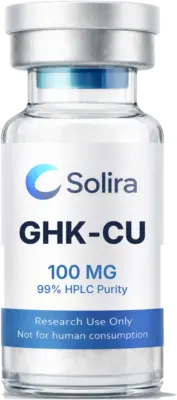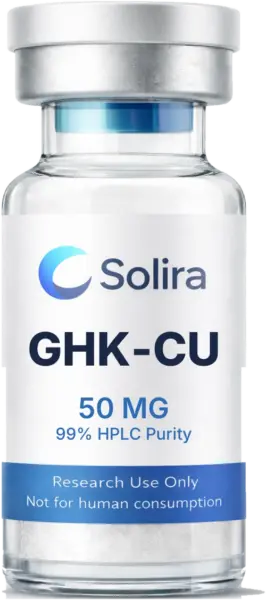
GHK-CU 50mg
Copper Tripeptide Complex
You save $15.60 Stock the Shelf applied automatically at checkout — no code needed
Direct-source pricing: Solira works through manufacturing partnerships to reduce reseller markup while maintaining independent third-party testing and lot-specific COA verification.
Estimated delivery Wed, Oct 14 – Tue, Oct 20
Availability: In stock
Quick facts
- Type
- Tripeptide copper complex (Gly-His-Lys + Cu2+)
- Purity
- HPLC-verified (see COA)
- Testing
- Third-party HPLC + mass spectrometry
- Form
- Lyophilized powder
- Shipping
- Same-day (orders before 3 PM ET)
- Use
- In-vitro laboratory research only
The Solira Take
GHK-Cu is a naturally occurring tripeptide-copper complex (glycyl-L-histidyl-L-lysine bound to Cu²⁺). 50 mg vial. Among the most-cited tripeptides in preclinical copper-binding and tissue-pathway literature.
Research reference
COA / Testing
Every batch of product sold by Solira undergoes independent third-party analytical testing to verify identity and purity, performed by Chromate.
- HPLC purity analysis — confirms compound purity
- Mass spectrometry — identity confirmation via molecular weight verification
- Lot-specific documentation — each COA corresponds to the specific manufacturing lot
Tested lot R56-481 (50 mg) — reference for all GHK-Cu sizes
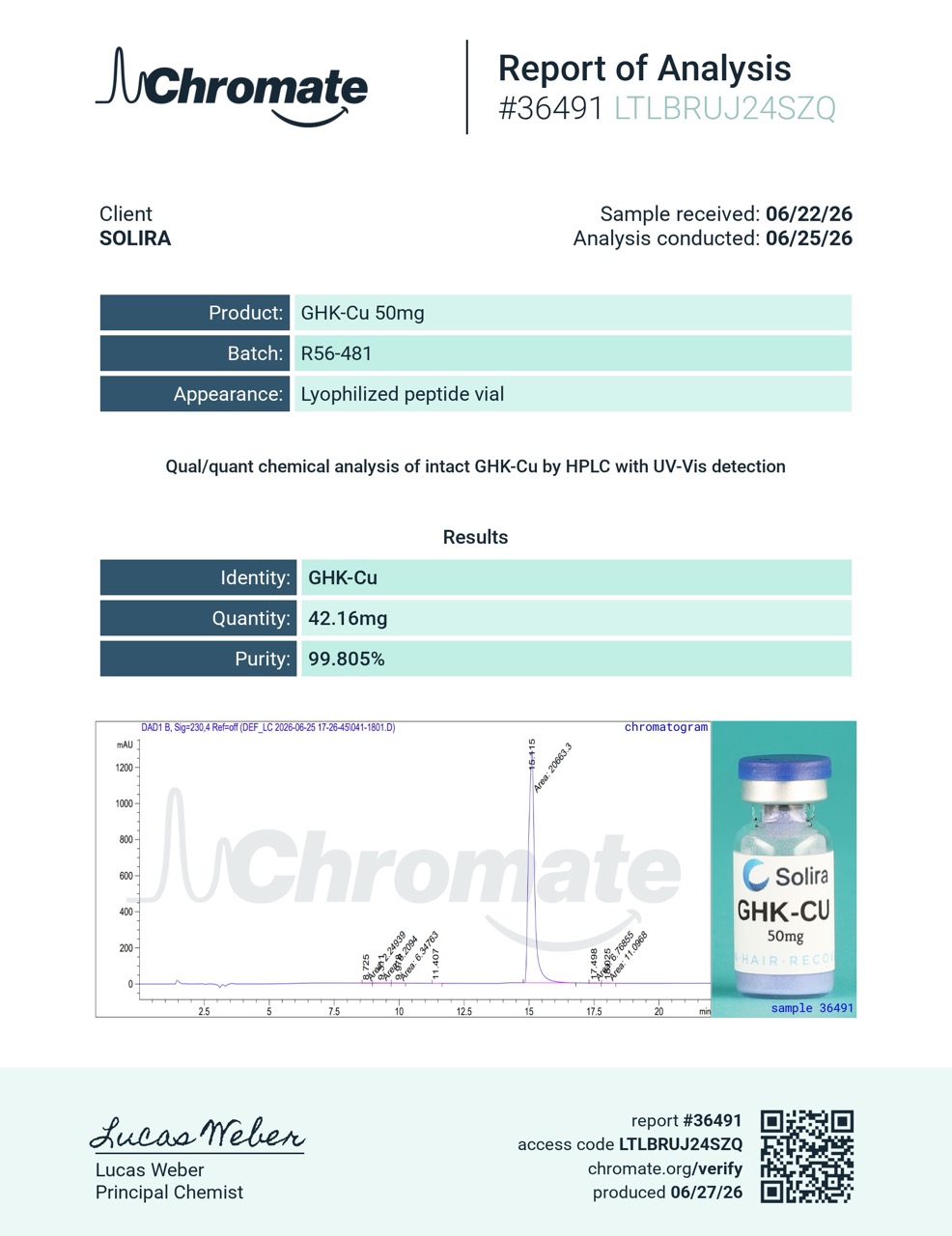
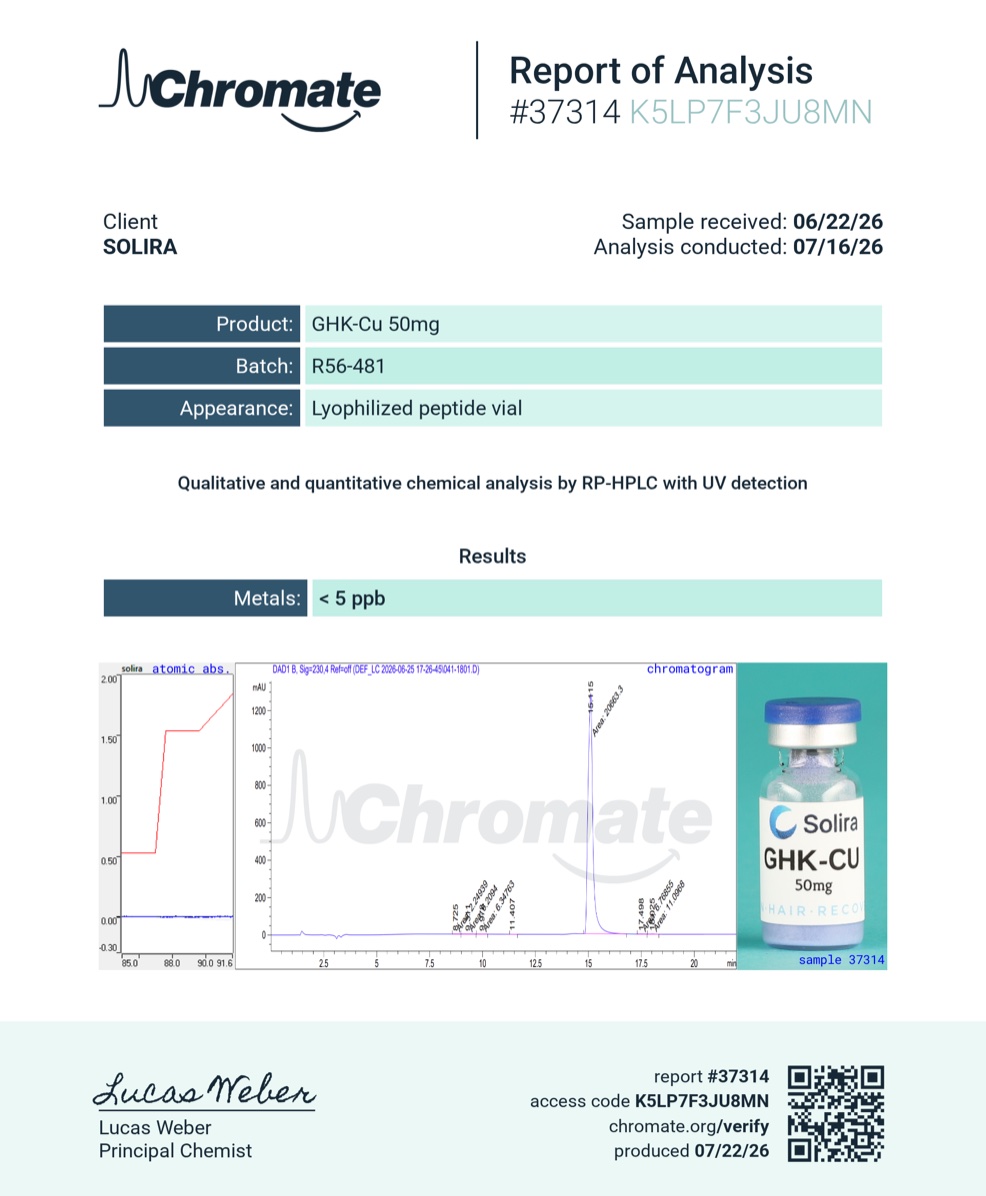
The full lab results for this lot are published in text on its Certificate of Analysis page. Each figure is also independently verifiable at Chromate, the testing laboratory.
Description
What is GHK-Cu?
GHK-Cu is a copper-bound tripeptide consisting of three amino acids — glycyl-L-histidyl-L-lysine (Gly-His-Lys, GHK) — complexed with a divalent copper ion (Cu2+). The tripeptide GHK itself is found endogenously in mammalian blood plasma at picomolar concentrations and declines with age in published serum studies. The copper-bound form (GHK-Cu) is the bioactive complex used in research applications. Molecular formula C14H24CuN6O4, molecular weight 404.92 g/mol. Solira supplies GHK-Cu as a deep-blue lyophilized powder in 50mg sealed vials.
Research Context
GHK-Cu is studied extensively in the preclinical research literature for its interactions with copper-binding proteins, redox biology, and gene-expression modulation assays. Published research models include cultured fibroblast lines, keratinocyte models, and a range of in-vitro tissue research preparations. The compound's distinctive copper chelation chemistry places it in its own structural class — most research peptides are pure-protein structures, whereas GHK-Cu is a metallopeptide whose copper coordination is central to its activity.
Mechanism of Action (Research Framing)
Published research characterizes GHK-Cu as a high-affinity copper carrier and modulator of copper-dependent enzyme systems. Mechanistic studies investigate its influence on:
- Lysyl oxidase activity — a copper-dependent enzyme central to extracellular matrix cross-linking research
- Antioxidant enzyme expression — research literature documents effects on superoxide dismutase (SOD) family enzymes and other redox regulators in cultured cells
- Transcriptomic modulation — a 2010 transcriptomic analysis catalogued effects on over 4,000 human genes in cultured fibroblast preparations, making GHK-Cu one of the most extensively-profiled peptides in research-grade transcriptomics literature. Subsequent meta-analyses have replicated subsets of the gene-expression pattern in independent fibroblast and keratinocyte preparations
- Copper-dependent signaling — broader research into copper-binding protein interactions, including investigations of metallothionein response in treated cell cultures
The copper coordination geometry is critical to the compound's behavior. GHK without copper has different binding kinetics and gene-expression signatures than GHK-Cu; researchers selecting between forms should consult their target literature carefully. The compound's deep-blue color is a direct visual indicator of intact copper coordination.
Standard Research Assays
Published GHK-Cu research commonly employs:
- RNA-seq and microarray transcriptomic profiling in cultured human fibroblasts (the classic 4,000-gene dataset originated this way)
- qPCR analysis of specific gene transcript expression following GHK-Cu exposure
- ELISA quantification of extracellular matrix protein expression (collagen types I and III)
- Spectrophotometric measurement of copper coordination state via absorbance shifts
- Cell-culture growth and migration assays in fibroblast and keratinocyte models
- Western blot analysis of metallothionein and SOD enzyme expression
- Lysyl oxidase enzymatic activity assays in extracellular matrix research
- Inductively coupled plasma mass spectrometry (ICP-MS) for cellular copper content measurement
- Electron paramagnetic resonance (EPR) spectroscopy for copper coordination state analysis
- Live-cell imaging with copper-responsive fluorescent probes
- Collagen synthesis assays via hydroxyproline quantification in fibroblast cultures
- Mitochondrial copper-pool measurement in isolated organelle preparations
- Confocal microscopy of copper distribution in subcellular compartments
- Quantitative proteomics for copper-binding protein interactome analysis
Researchers working with metallopeptide compounds should also characterize their buffer system for trace copper contamination, which can confound the interpretation of copper-coordination-dependent effects in cell culture experiments. Standard glassware and serum-containing media typically introduce sufficient background copper to perturb low-concentration GHK-Cu assays, and chelator-purified buffers are commonly used in mechanistic research applications.
Why Purity Matters for Research Validity
For a metallopeptide like GHK-Cu, purity has two dimensions: the peptide chain must be high-purity by HPLC, AND the copper coordination must be stoichiometrically correct (one Cu2+ per tripeptide molecule). Free copper ions in a "GHK-Cu" preparation behave entirely differently in research assays than properly-bound complex — copper toxicity in cell culture, for instance, is concentration-dependent and easily mistaken for compound effect.
Solira's independent HPLC verification combined with mass spectrometry identity confirmation documents both dimensions on each lot's COA.
Solira's Quality Verification
Every lot of GHK-Cu from Solira undergoes independent third-party HPLC analysis plus mass spectrometry identity confirmation. The lot-specific Certificate of Analysis documents the lot number, methodology, equipment specifications, copper coordination verification, and purity percentage. See Solira's full verification process →
Storage & Handling
Lyophilized GHK-Cu is stable for 24 months or longer at −20°C in its sealed vial, protected from light and moisture. The compound's characteristic deep-blue color is a property of the Cu2+ coordination — significant color change in the lyophilized powder may indicate copper dissociation and should prompt fresh purchase. Reconstituted GHK-Cu must be kept refrigerated; aqueous solutions are not freeze-stable for repeated freeze-thaw cycles. View Solira's compound reference database →
Product Specs
Research Applications
- Investigated in preclinical models for copper ion transport and chaperone activity in cellular systems.
- Studied in in vitro systems for collagen and elastin gene expression in dermal fibroblast cultures.
- Used in laboratory research examining extracellular matrix component turnover.
- Evaluated in controlled preclinical settings for antioxidant enzyme pathway modulation.
Storage & Handling
Store sealed, dry, and protected from light.
Long-term storage: -20°C recommended.
Short-term storage: 2-8°C acceptable.
Reconstitution: Use sterile technique with bacteriostatic water.
Post-reconstitution: Stable up to 30 days at 2-8°C.
All handling instructions are intended for laboratory use only.
Sold to qualified researchers for laboratory use only. These products have not been evaluated by the FDA, are not intended to diagnose, treat, cure or prevent any disease, and are not for human, veterinary, or food use in any form. The purchaser is responsible for the lawful and proper use of any compound purchased.