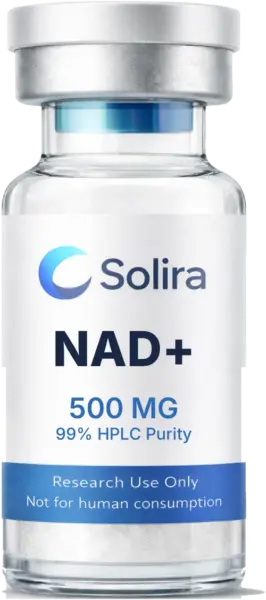
NAD+
Nicotinamide Adenine Dinucleotide
You save $26.80 Stock the Shelf applied automatically at checkout — no code needed
Direct-source pricing: Solira works through manufacturing partnerships to reduce reseller markup while maintaining independent third-party testing and lot-specific COA verification.
Estimated delivery Wed, Oct 14 – Tue, Oct 20
Availability: In stock
Quick facts
- Type
- Pyridine nucleotide coenzyme
- Purity
- HPLC-verified (see COA)
- Testing
- Third-party HPLC + mass spectrometry
- Form
- Lyophilized powder
- Shipping
- Same-day (orders before 3 PM ET)
- Use
- In-vitro laboratory research only
The Solira Take
NAD+ (nicotinamide adenine dinucleotide) is a coenzyme central to cellular redox reactions. Used in preclinical research on metabolism, sirtuin-pathway, and mitochondrial mechanisms.
Research reference
COA / Testing
Every batch of product sold by Solira undergoes independent third-party analytical testing to verify identity and purity, performed by Chromate.
- HPLC purity analysis — confirms compound purity
- Mass spectrometry — identity confirmation via molecular weight verification
- Lot-specific documentation — each COA corresponds to the specific manufacturing lot
COA available upon request. Contact us for lot-specific documentation.
Description
What is NAD+?
NAD+ (nicotinamide adenine dinucleotide, oxidized form) is a pyridine nucleotide coenzyme present in every living cell. Structurally, NAD+ consists of two nucleotides — one containing adenine, the other nicotinamide — joined by a pair of phosphate groups. It exists in two redox states (NAD+ and NADH) and is central to cellular electron-transfer chemistry. Molecular formula C21H27N7O14P2, molecular weight 663.43 g/mol. Solira supplies NAD+ as a lyophilized white-to-off-white powder in sealed vials for laboratory research only.
Research Context
NAD+ is studied across an extensive preclinical research literature spanning cellular metabolism, mitochondrial bioenergetics, sirtuin enzymology, and DNA-repair pathway research. Standard research models include cultured cell lines (often with mitochondrial reporter constructs), isolated mitochondrial preparations, and yeast and worm model organisms for cellular vitality studies.
NAD+ is not a peptide; it is included in Solira's cellular vitality research category because it is the primary research cofactor in this domain.
Mechanism of Action (Research Framing)
NAD+ serves as the obligate electron acceptor for a large class of enzymes (oxidoreductases) and as the substrate for several NAD+-consuming enzyme families:
- Sirtuins (SIRT1 through SIRT7) — NAD+-dependent deacylases studied in cellular metabolism, chromatin biology, and mitochondrial function research
- PARP family (PARP1, PARP2) — NAD+-consuming poly-ADP-ribose polymerases involved in the DNA damage response
- CD38 — a NAD+ glycohydrolase that has emerged as a major NAD+ consumer in research literature on age-related cellular metabolism
- SARM1 — a NAD+ cleaving enzyme studied in axon-degeneration research
Research investigations of NAD+ in cultured cells typically focus on cellular NAD+/NADH ratio measurements, sirtuin activity assays, and mitochondrial respiration measurements via Seahorse-style extracellular flux methodology. Cellular NAD+ concentrations decline measurably with age in published animal studies, which has driven a substantial body of research literature investigating NAD+ precursor compounds (nicotinamide mononucleotide, nicotinamide riboside) in research models. Researchers selecting NAD+ for in-vitro work should consult target methodology carefully — NAD+ in solution has stability characteristics distinct from those of common precursor compounds.
Standard Research Assays
Published NAD+ research commonly employs:
- Cyclic enzymatic assays for NAD+/NADH ratio measurement in cell extracts
- HPLC quantification of NAD+ and its metabolites in tissue lysates
- Sirtuin activity assays using fluorescent peptide substrates
- Seahorse XF extracellular flux analysis for mitochondrial respiration
- qPCR analysis of NAD+-pathway gene expression (NAMPT, NMNAT1-3, NRK1-2)
- Western blot for SIRT1, SIRT3, and other sirtuin family members
- Mass spectrometry-based metabolomics for NAD+ flux measurements
- Bioluminescence assays using NAD+-dependent luciferase reporters
- NMR spectroscopy for direct quantification of NAD+ in tissue extracts
- Flow cytometry analysis of NAD+-dependent enzyme activity with fluorescent substrates
- CRISPR-based functional screens for NAD+ biosynthesis pathway components
- Stable-isotope-tracer flux analysis for NAD+ metabolism research
- Computational network analysis of NAD+-dependent enzyme expression
- Real-time NAD+/NADH ratio measurement with genetically-encoded fluorescent biosensors
- Multi-omic integration of NAD+ metabolomics with transcriptomic and proteomic datasets
The mitochondrial subcellular pool of NAD+ has distinct kinetic and concentration characteristics from the cytosolic and nuclear pools, and researchers using compartment-resolved methodology should consult specialized literature on subcellular NAD+ measurement before assay design. Tissue-specific NAD+ research methodology also varies significantly across hepatic, neuronal, and skeletal-muscle preparations, with each requiring distinct extraction and quantification protocols documented in the published literature.
Why Purity Matters for Research Validity
Research-grade NAD+ must be high-purity to function correctly in enzymatic assays. Common impurities include hydrolysis products (nicotinamide mononucleotide, ADP-ribose, free nicotinamide) and oxidation variants. Even small percentages of hydrolyzed material change the kinetic constants of every NAD+-dependent enzyme assay and confound the interpretation of cellular NAD+/NADH ratio measurements. A 95% pure NAD+ preparation is essentially a mixture, not a defined reagent.
Solira's independent HPLC verification preserves the experimental clarity that NAD+ enzymology research demands.
Solira's Quality Verification
Every lot of NAD+ from Solira undergoes independent third-party HPLC analysis plus mass spectrometry identity confirmation. The lot-specific Certificate of Analysis documents the lot number, methodology, and the exact purity percentage for the lot in your vial. See Solira's full verification process →
Storage & Handling
Lyophilized NAD+ is stable for 24 months or longer at −20°C in its sealed vial, protected from light, moisture, and oxidative atmosphere. The compound is particularly sensitive to humidity — research labs routinely store NAD+ vials with desiccant. Once reconstituted in research-grade buffer (typically Tris-HCl at pH 7.0–7.4), the resulting solution must be kept refrigerated and used promptly; NAD+ in aqueous solution is significantly less stable than the lyophilized form. View Solira's compound reference database →
Product Specs
Research Applications
- Investigated in preclinical models for sirtuin (SIRT1-7) enzyme activity and NAD+-dependent deacetylation research.
- Studied in in vitro systems for PARP enzyme substrate kinetics.
- Used in laboratory research examining cellular redox state and NAD+/NADH ratio.
- Evaluated in controlled preclinical settings for mitochondrial electron transport chain cofactor dynamics.
Storage & Handling
Store sealed, dry, and protected from light.
Long-term storage: -20°C recommended.
Short-term storage: 2-8°C acceptable.
Reconstitution: Use sterile technique with bacteriostatic water.
Post-reconstitution: Stable up to 30 days at 2-8°C.
All handling instructions are intended for laboratory use only.
Sold to qualified researchers for laboratory use only. These products have not been evaluated by the FDA, are not intended to diagnose, treat, cure or prevent any disease, and are not for human, veterinary, or food use in any form. The purchaser is responsible for the lawful and proper use of any compound purchased.